
Federal Budget 2026–27 Property Update: What the Changes Mean for Buyers and Investors
Federal Budget 2026–27 Property Update: What the Changes Mean for Buyers and Investors
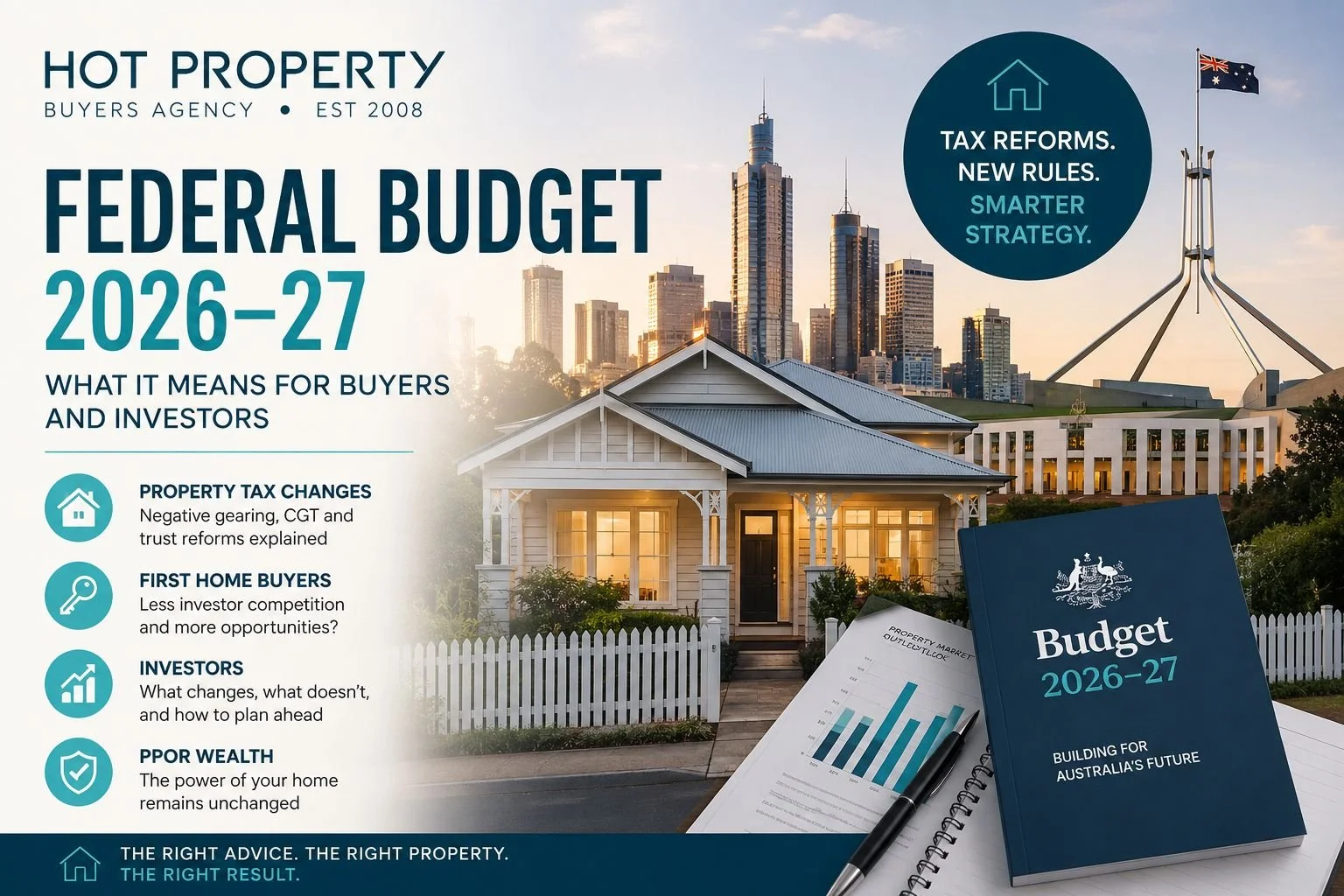
The 2026–27 Federal Budget has put property tax firmly in the spotlight, with proposed changes to negative gearing and capital gains tax designed to shift more investor activity toward new housing supply and make it easier for first home buyers to compete.
There is a lot of noise around these changes, and it would be easy for buyers and investors to feel like the property rulebook has been thrown into a blender. But the key message is this:
Don’t panic. Don’t rush. Don’t assume property is suddenly broken. The rules are changing, but good property strategy still matters.
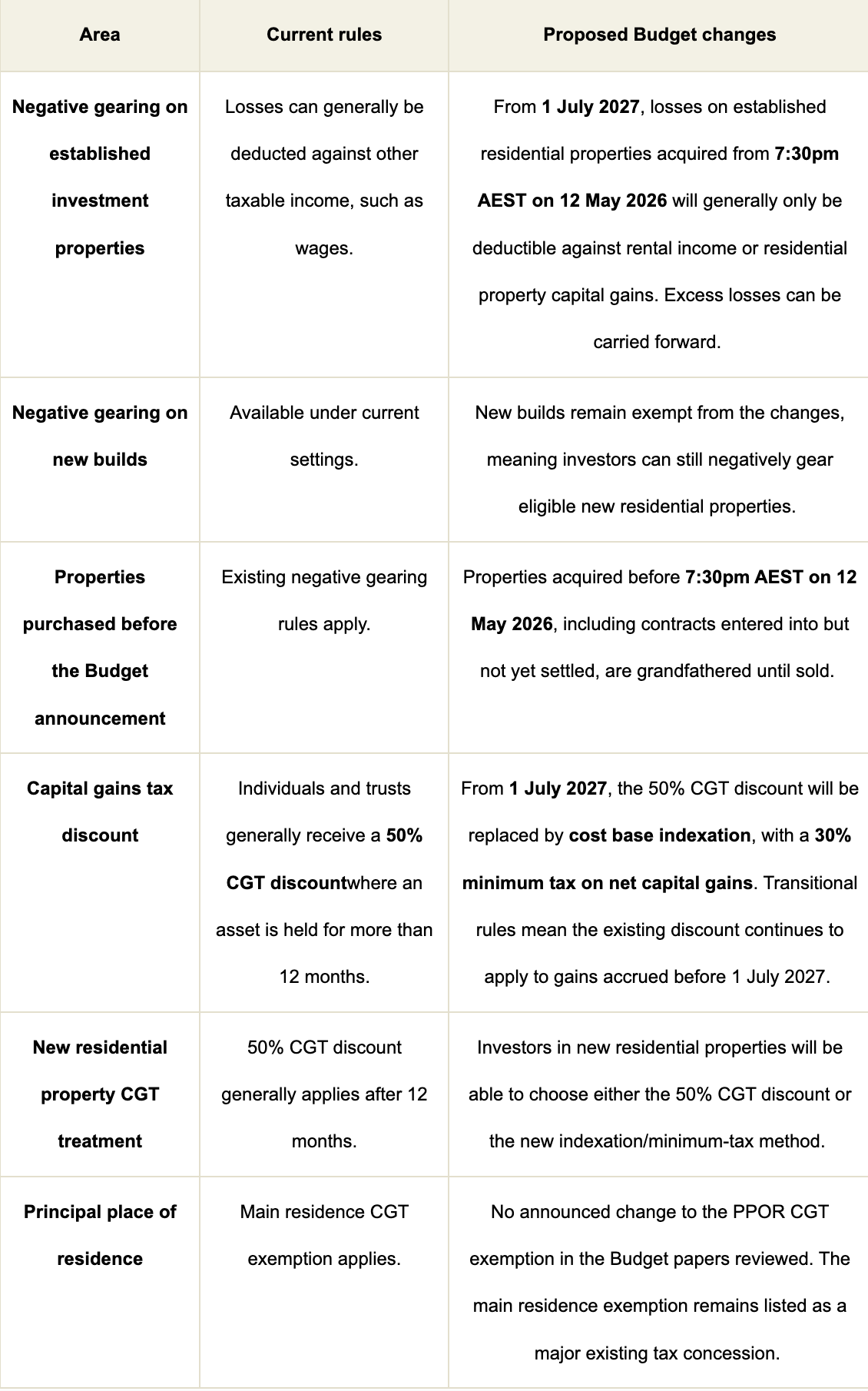
The biggest changes at a glance
The key message for investors: don’t panic sell
For anyone who already owns an investment property, the most important point is the grandfathering.
The Budget papers make it clear that established residential properties acquired before 7:30pm AEST on 12 May 2026 will be exempt from the negative gearing changes until they are sold. This includes contracts entered into before that time, even if they had not yet settled.
That means investors should be very careful before making emotional decisions.
Selling a quality asset simply because the headlines are loud could be a costly mistake. A well-located property with strong land value, rental demand, scarcity and long-term owner-occupier appeal may still be an excellent asset. The tax treatment is only one part of the overall investment equation.
Before selling, investors should consider:
whether the property is already grandfathered
the long-term capital growth outlook
rental demand and future yield
land value and scarcity
transaction costs of selling and buying again
their personal tax position
whether the property still fits their broader wealth strategy
This is definitely a time for advice, not knee-jerk decisions.
The PPOR may become even more important as a wealth strategy
One of the most important takeaways from the Budget is what didn’t change.
There has been no announced change in the Budget papers we reviewed to the capital gains tax exemption for the principal place of residence. The main residence exemption remains listed in Budget Paper No. 1 as one of the major existing tax concessions. That matters.
For many Australians, the family home may become an even more attractive long-term wealth-building strategy because it continues to provide:
lifestyle value
housing security
potential long-term capital growth
no land tax in Queensland for a true PPOR under current state settings
no CGT on eligible capital gains under the existing main residence exemption
the ability to renovate, improve and manufacture value over time
For clients weighing up whether to buy an investment property or upgrade their home, the Budget reinforces something we have always believed: your principal place of residence can be a serious wealth creation vehicle, not just a place to live.
A high-quality PPOR in a strong Brisbane location can provide both emotional and financial returns. It gives your family stability while potentially allowing you to build significant tax-effective wealth over time.
In plain English: the family home is not the “boring” option. In this new environment, it may be one of the cleanest and most powerful property strategies available.
What this means for established investment properties
The Government’s direction is clear. It wants to reduce tax incentives for investors buying established homes and redirect more investment toward new housing supply.
Budget Paper No. 1 says the reforms are intended to better target tax support toward housing supply rather than existing homes. It also notes that current settings can encourage speculation in existing dwellings and add to housing demand.
For investors, this means established properties will need to stand on their own merits more than ever.
The “buy anything and let the tax loss help carry it” approach is likely to become less attractive for new purchases after the relevant dates. Investors will need to be sharper on:
asset quality
cash flow
rental growth
land content
location fundamentals
vacancy risk
renovation upside
long-term buyer demand
Good established property will not suddenly become bad property. But poor-quality established property that relied heavily on tax benefits to make the numbers work may become far less appealing.
What this means for new builds
New builds are the Budget’s favoured child in the property family portrait.
Eligible new residential properties are exempt from the negative gearing changes, and investors in new residential property will also be able to choose between the 50% CGT discount or the new cost base indexation/minimum-tax approach.
That does not mean every new build is automatically a good investment.
Investors still need to be careful. New property can come with risks around developer margins, oversupply, poor land content, body corporate costs, location quality, defects, settlement valuation risk and weaker resale demand.
The Budget may make new builds more attractive from a tax perspective, but tax should never be the only reason to buy.
What this means for first home buyers
First home buyers are the intended winners of these reforms.
The Government is trying to reduce investor competition for established homes and make it easier for owner-occupiers to compete. Budget Paper No. 1 says the reforms are expected to support more first home buyers into the housing market over time.
However, buyers should be realistic.
In strong Brisbane suburbs where supply is tight and owner-occupier demand is deep, competition is not going to disappear. A great home in a great location will still attract attention.
The Budget may change some investor behaviour, but it does not remove scarcity. It does not create more character homes in Hendra, Clayfield, Ascot, Wavell Heights or inner Brisbane overnight. Quality property will still be quality property.
Our view
The Budget does not kill property investment. It changes the strategy.
For existing investors with grandfathered properties, now is the time to review your portfolio carefully, not panic sell.
For future investors, the bar for asset selection has been raised. Buying the right property, in the right structure, with the right advice, matters more than ever.
For homeowners and upgraders, the PPOR remains a very compelling strategy. With no announced change to the main residence CGT exemption, the family home continues to offer one of the most tax-effective pathways to long-term wealth creation.
For Brisbane buyers, the fundamentals remain the fundamentals: scarcity, location, land, lifestyle, school zones, transport, renovation potential and long-term demand still matter.
The Budget may have changed the tax settings, but it has not changed the golden rule of property:
Buy the right asset, for the right reason, with a long-term plan.
Before making any decisions, speak with your accountant, financial adviser and property adviser. The right move will depend on your personal circumstances, your structure and your long-term goals.

Head to our website to read more about our trusted process and get in touch.